

Black Friday 2025 just wrapped.
And the numbers? They’re huge.
We’re talking $11.8B in U.S. online sales. Record-breaking holiday totals. AI driving billions in purchases.
But here’s what matters more than the hype: how people actually shopped.
Because if you’re planning for next year, you need to know what worked, and what’s changing fast.
Let’s break it down.
Editor’s picks (2025)
- U.S. online sales hit a record $11.8B on Black Friday 2025, up 9.1% from 2024.
- 87.3M people shopped online and 81.7M shopped in stores on Black Friday 2025.
- Shopify merchants generated $14.6B in BFCM sales in 2025, up 27% YoY.
- AI influenced $3B in online sales on Black Friday 2025, and AI-driven traffic jumped 693.4%.
- Total U.S. retail sales for November 2025 came in at $735.9B, up 0.6% month over month.
- Mastercard reported e-commerce grew 10.4% YoY on Black Friday 2025.
- Mobile shopping made up 69% of purchases worldwide.
2025 wasn’t just about big numbers. It was about efficiency.
Online spending hit a new record.
And physical stores? They still brought in huge crowds.
That mix is important. It shows shoppers weren’t picking one channel over the other.
They were just grabbing deals however they could.
AI also proved it’s a real sales driver, not just hype.
So if you’re planning for the next holiday season, here’s what matters: you need a solid mobile-first online experience, and you can’t ignore what’s happening in stores.
Sources:
- $11.8B online sales (2025 Black Friday sales) – Adobe
- 87.3M online shoppers + 81.7M in-store shoppers – NRF
- $14.6B Shopify BFCM sales 2025 – Shopify
- $3B AI-influenced sales + 693.4% AI traffic growth – Adobe
- $735.9B total U.S. retail sales (Nov 2025) – Investopedia
- 10.4% e-commerce growth – Business Wire
Online sales surge (2025)
- U.S. online sales hit $11.8B on Black Friday 2025, up 9.1% YoY.
- Total online holiday sales in 2025 reached a record $257.8B.
- Shopify merchants generated $14.6B in BFCM 2025 sales, up 27% YoY, with peaks of $5.1M per minute in transactions.
- Mastercard reported e-commerce grew 10.4% YoY on Black Friday 2025.
- Mobile drove 55% of U.S. online sales on Black Friday 2025.
- Global Black Friday 2025 spending touched $79B, up 6.18% YoY.
Here is a table displaying the Black Friday sales by year:
| Years | Total online sales in U.S |
| 2025 | $11.8 billion |
| 2024 | $10.8 billion |
| 2023 | $9.8 billion |
| 2022 | $9.12 billion |
| 2021 | $8.92 billion |
| 2020 | $9.03 billion |
| 2019 | $7.4 billion |
| 2018 | $6.2 billion |
| 2017 | $5 billion |
2025 wasn’t just a big Black Friday. It was a massive online season.
That $11.8B single day proves online demand keeps growing, even when people are careful with spending.
And the $257.8B total for the holidays shows this goes way beyond one weekend.
But here’s what really matters: how people shopped.
55% of sales came from mobile. Shoppers grabbed deals from anywhere, not just sitting at a computer.
Shopify’s $14.6B makes it clear that independent brands and direct-to-consumer stores captured a huge piece of the action.
Sources:
- $11.8B U.S. online sales (Black Friday 2025) – Adobe
- $257.8B total online holiday sales 2025 – Adobe
- $14.6B Shopify BFCM sales + $5.1M per minute peak (2025) – Shopify
- 10.4% e-commerce growth – Business Wire
- 55% mobile share of U.S. online sales – LinkedIn
In-store vs. hybrid shopping
- On Black Friday, 81.7M people shopped in stores, up from 76.2M in 2023.
- 87.3M people shopped online, down slightly from 90.6M in 2023.
- Over Thanksgiving through Cyber Monday 2025, 129.5M people shopped in-store (up 3%) and 134.9M shopped online (up 9%).
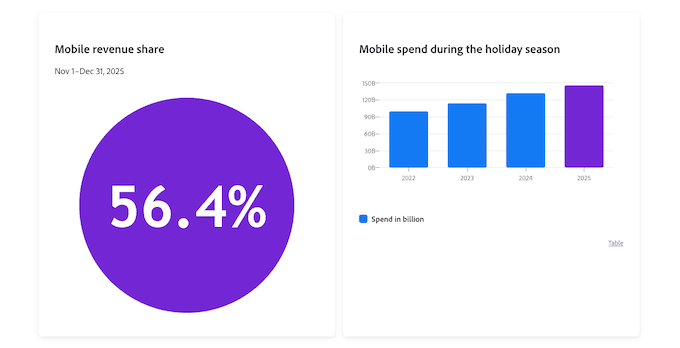
- Mobile drove 56.4% of sales (that’s $145.2B) in 2025. Desktops brought in 43.6% ($112.6B).
- A 2025 survey found 71% prefer shopping online, while 29% prefer in-store.
- For in-store shopping in 2025, Walmart (71%) and Target (56%) were the top destinations.
In-store shopping didn’t disappear.
But 2025 wasn’t about choosing between online or in-store.
It was clearly hybrid.
People looked up deals online, then grabbed them in-store when it made sense.
And when shoppers showed up, they came ready to buy, not just to look around.
💡 Quick takeaway: If your Black Friday plan only focuses on one channel, you’re leaving money on the table.
Sources:
- 81.7M in-store shoppers (2024 Black Friday sales) – NRF
- 87.3M online shoppers (Black Friday 2024) – NRF
- 129.5M in-store + 134.9M online shoppers (Thanksgiving–Cyber Monday 2025) – CNBC
- Mobile drove 56.4% of sales in 2025 – Adobe
- 71% prefer online, 29% prefer in-store (2025 survey) – Drive Research
- Walmart (71%) + Target (56%) as top in-store spots (2025) – Drive Research
AI and Tech influence
- AI influenced $3B in online sales on Black Friday 2025.
- AI-driven traffic jumped 693.4% on Black Friday 2025.
- Around 1 in 3 consumers used AI in 2025, and 53% used it for research.
- AI-fueled traffic to electronics pages surged 355% on Black Friday 2024.
- AI-fueled traffic to sporting goods pages rose 335% on Black Friday 2024.
AI made a real difference in 2025.
But it wasn’t just hype.
It actually drove shoppers to stores and product pages. And it drove real sales too.
The category spikes tell you where AI shopping tools work best: high-consideration products like electronics, and deal-hunting categories like sporting goods.
If you’re creating Black Friday content, make your pages easy to skim, compare, and decide on.
That’s exactly what shoppers are using AI for.
Sources:
- $3B AI-influenced online sales- Adobe
- 693.4% AI-driven traffic growth- Adobe
- 355% electronics traffic via AI – Criteo
- 335% sporting goods traffic via AI on Black Friday – Criteo
Payment and spending trends (2025)
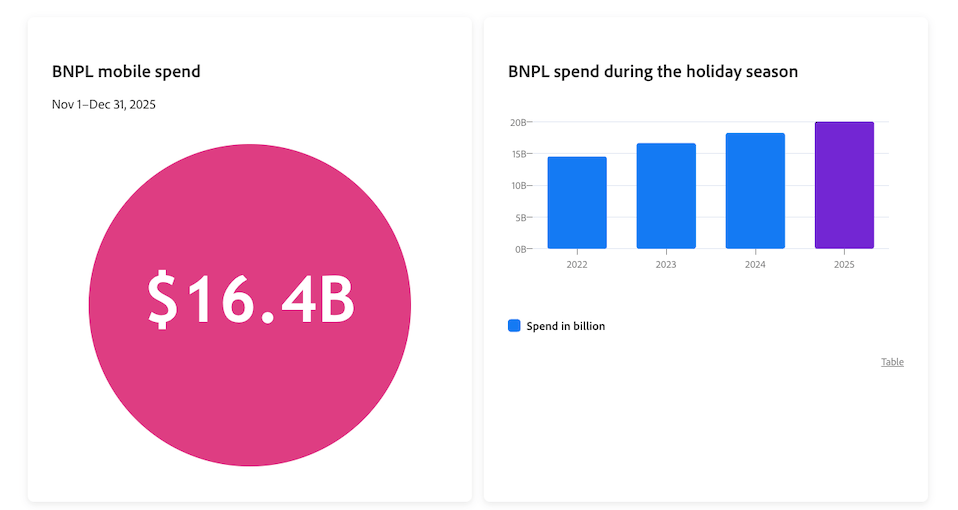
- Buy now, pay later (BNPL) didn’t slow down in 2025. Shoppers spent $20.0B through BNPL this holiday season, up 9.8% from 2024. Mobile accounted for $16.4B of that $20B.
- Total U.S. retail sales for November 2025 came in at $735.9B, up 0.6% month over month.
- Holiday sales were projected to rise 4.1% in Nov-Dec 2025.
- A 2025 survey found 24% of shoppers planned to spend $1,000+.
Buy now, pay later (BNPL) didn’t just grow in 2025.
It became the release valve for tight budgets.
When shoppers spread payments out, they feel safer buying earlier and buying more.
At the same time, overall retail sales stayed strong, even with inflation still in the background.
And that combo tells you something important.
Shoppers didn’t stop spending. They just got smarter about how they paid.
Sources:
- BNPL sales (Nov – Dec 2025) – Adobe
- $735.9B total U.S. retail sales (Nov 2025) – Investopedia
- 4.1% holiday sales growth projection (Nov–Dec 2025) – NRF
- 24% planned $1,000+ spend (2025 survey) – Drive Research
Consumer behavior insights (2025)
- 88% of shoppers planned to shop during Cyber Week in 2025, which tells you most people had already blocked time (and budget) for the deals.
- 80% of shoppers said discounts were their main motivator in 2025, so price still beat everything else.
- 75% of shoppers started researching before mid-November 2025, which means the “shopping window” started weeks earlier than the sale days.
- 70% of shoppers said Black Friday 2025 was the most important shopping day, even with Cyber Monday and the full Cyber Week hype.
- The top categories in Black Friday 2025 were clothing (in-person shopping 80% & online 77%) and electronics (in-person 70% & online 69%).
The data tells a clear story.
Shoppers didn’t just wake up on Black Friday and decide to buy.
They planned weeks in advance.
They researched before mid-November.
And they cared about one thing more than anything else: discounts.
If you’re running campaigns around BFCM, you’re not just competing on sale day. You’re competing during the research phase.
Sources:
- 88% planned Cyber Week shopping (2025) – Drive Research
- 80% motivated by discounts (2025) – Drive Research
- 75% researched before mid-November (2025) – Impact
- 70% said Black Friday was the top day (2025) – NRF
- Top categories: clothing (77–80%) and electronics (69–70%) (2025) – Drive Research
Verdict
Black Friday 2025 wasn’t just another shopping event.
It was a signal of how retail is evolving.
Shoppers spent more online than ever before, but they didn’t abandon stores.
They used AI to research smarter, not just faster.
They leaned on BNPL to stretch budgets without cutting back. And they started planning weeks before the actual sale days hit.


